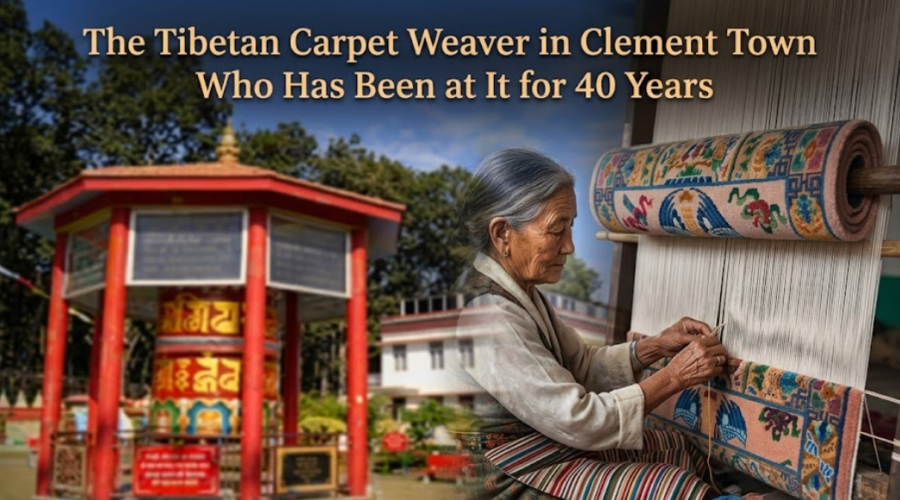
In Clement Town, one of Dehradun’s largest Tibetan settlements, a weaver in his early seventies still sits at his loom for several hours each day. He has been weaving Tibetan carpets since 1984. His hands work without hesitation, pulling wool threads through a tight lattice of warp strings, tying knots in the traditional Tibetan style, each one placed by memory rather than calculation. The Tibetan carpet weaver in Clement Town is not a relic. He is one of the last people keeping an old craft alive in a city that has long since moved on to other things.
Types of Tibetan Carpets Available in Clement Town
| Type | Size | Price Range |
|---|---|---|
| Traditional Dragon Motif | 3×5 ft | Rs 8,000 to Rs 15,000 |
| Floral Pattern | 5×8 ft | Rs 18,000 to Rs 30,000 |
| Mandala Design | 4×6 ft | Rs 12,000 to Rs 22,000 |
| Custom Woven | Any size | Rs 2,500 per sq ft |
To understand the Tibetan community in Dehradun more broadly, read about how Tibetan culture shaped Dehradun’s bazaars and restaurants.
Clement Town and the Tibetan Carpet Weaving Tradition
Clement Town’s Tibetan community arrived in Dehradun in the 1960s following the Tibetan diaspora after 1959. The settlement, known formally as Dekyiling, grew into one of the largest Tibetan refugee settlements in India. Along with monasteries, schools, and temples, the settlers brought their crafts. Carpet weaving was among the most important of these. It was a source of income, a way to preserve cultural identity, and a practice passed between generations.
The Dekyiling Handicraft Centre, set up with support from the Tibet Relief Fund, became the formal home for this craft in Dehradun. Its purpose was to preserve traditional handloom weaving while providing employment for skilled weavers and training younger Tibetans in the trade. At its peak, the centre employed dozens of weavers. Today, those numbers have shrunk considerably.
What the Work Actually Looks Like
A Tibetan carpet is hand-knotted. A single carpet measuring 3 feet by 6 feet takes roughly one month to complete. Each knot is tied individually, with the pile cut after each row. Traditional designs include dragons, birds, snow-capped mountains, lotus flowers, and scenes from nature. The wool comes mainly from sheep raised in high-altitude regions, chosen for its density and durability.

The weaver describes the work as physical but calming. You cannot rush it. A carpet woven in haste will show it. The knot count per square inch determines quality. High-quality Tibetan carpets carry 60 to 100 knots per square inch. At that density, a 6-by-9-foot carpet holds more than 777,000 individual hand-tied knots.
There is no shortcut. Machine-made carpets from China and India have flooded the mid-range market. Buyers who are not looking carefully cannot tell the difference from a photograph. But the hand-knotted carpet lasts 40 to 80 years with basic care. A machine-made carpet does not.
The Market and the Struggle
The main buyers for Clement Town’s hand-knotted carpets have always been foreign tourists passing through Mussoorie and Dehradun, as well as export orders. The Tibetan Women’s Centre in Dehradun, which also runs a weaving programme, sells carpets directly to buyers. Orders come from places as far as Himachal Pradesh and Delhi. But foot traffic has dropped since the pandemic years, and export logistics remain complicated for small operations.
The bigger problem is succession. Young Tibetans in Clement Town are not interested in spending a month producing a single carpet for a modest return. The work is skilled, intensive, and poorly compensated compared to what a young person can earn in a service job in Dehradun’s growing IT and hospitality sectors. The weaver acknowledges this without bitterness. He says he taught three apprentices over the past 15 years. Only one still practices the craft.
What Gets Lost When This Ends
Tibetan carpet patterns are not merely decorative. Each motif carries meaning. The dragon represents protection and power. The lotus symbolises purity in Buddhist thought. The endless knot, appearing frequently in Tibetan textile traditions, represents the interconnection of all things. When a weaver makes these designs, he is not just filling space. He is reproducing a visual vocabulary that has survived centuries of displacement.
The Dehradun Tibetan community has worked to document these patterns and techniques. Some designs are recorded. But documentation is not the same as practice. A design drawn on paper does not carry the same weight as a design tied, knot by knot, into wool by someone who learned it from their parents.
If you want to see this craft, the Dekyiling settlement in Clement Town is accessible and open to visitors. The Tibetan Women’s Centre and the Tibetan Handicraft Centre both welcome people who are genuinely interested in what they produce. Buying a hand-knotted carpet directly from these centres keeps money in the community and gives the craft a reason to continue. That is the most direct way to help. You can also explore more about Dehradun’s cultural communities and their traditions to understand how the city’s diverse heritage shapes its present.
According to the Tibet Relief Fund, which has supported the Dekyiling community since its early years, the handicraft centre’s mission was always about more than economics. It was about keeping people connected to who they were before they had to leave. That mission has not changed. The question is whether enough people outside the community care enough to keep it viable.


Leave a Reply