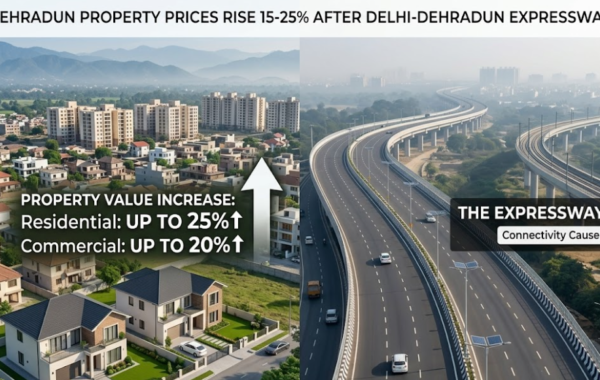
Two weeks after Prime Minister Narendra Modi inaugurated the Delhi-Dehradun Expressway on April 14, 2026, the Delhi Dehradun Expressway property market 2026 is already showing measurable movement. Property prices along Rajpur Road, the Mussoorie foothills, and the Rishikesh corridor are recording 15 to 25 percent appreciation, with some pockets like Selakui seeing even sharper gains. The 210-kilometre, six-lane corridor cuts the Delhi-to-Dehradun journey from six hours to two and a half, and that change is reshaping how buyers, renters, and long-time residents think about living in Doon.
The expressway’s effect is not a future projection. It is already visible in inquiry volumes, site visits, and transaction prices across Dehradun’s key micro-markets. Here is what has changed and what it means depending on where you sit in the market.
Which Areas Are Moving Fastest
Selakui, on the Dehradun-Haridwar corridor near the expressway’s Dehradun-end access points, has recorded some of the sharpest gains: property rates climbed from Rs 7,312 per square foot in early 2025 to Rs 9,008 per square foot by December 2025, a 23 percent increase before the expressway even opened. With inauguration now complete, analysts expect Selakui to continue outperforming broader Dehradun market averages through 2026.
Rajpur Road, historically Dehradun’s premium residential corridor, is seeing renewed interest from Delhi-based buyers seeking second homes. The calculation has shifted: a property on Rajpur Road is now 2.5 hours from Connaught Place on a clear day, a distance that changes the definition of a weekend escape. Mussoorie foothills neighbourhoods, about 35 kilometres from Dehradun centre, are seeing similar interest from buyers who want elevation, views, and hill town character within an easy drive of the expressway access point.
Who Is Buying and Why
Two buyer profiles are driving 2026 demand. The first is Delhi-based investors and second-home seekers who had been watching Dehradun but waiting for the connectivity to improve. The expressway removed that hesitation. The second profile is professionals relocating from Delhi entirely, prioritising air quality, lower density, and proximity to nature without sacrificing career access to the capital. Both groups are driving demand for finished inventory: ready-to-move apartments and villas with existing amenities, not raw land.
Eco-friendly developments with green spaces, water recycling, and energy-efficient construction are pulling a premium among relocating buyers who see a quality-of-life upgrade as part of the value proposition. Developers who had positioned projects around the Delhi Dehradun Expressway property market years ago are now converting those positions into sales at prices that reflect the improved fundamentals.
What Long-Time Doon Residents Should Know
For residents who already own property in Dehradun, the expressway effect is net positive on paper: asset values are rising. The risk is on the other side: rental prices for quality housing are moving up, and the city’s character is shifting as weekend tourism density increases. Neighbourhoods that were quiet on weekends are seeing more traffic, more noise, and more demand for commercial services catering to visitors.
Infrastructure is the constraint. Water supply, sewage, and road capacity within Dehradun city limits have not expanded at the same pace as the interest the expressway has generated. The Dehradun Smart City initiative has projects underway to address some of this, but the pace of infrastructure improvement will determine whether the property boom translates into sustained livability or leads to the congestion and strain that have affected other hill towns when connectivity improved faster than capacity. For more on how residents are experiencing the change, see our piece on how Dehradunites are feeling the expressway effect.


Leave a Reply